What Is an Air Handling Unit? A Plain-English Guide for UK Homeowners
If you've been looking into ways to improve your home's heating, cooling, or indoor air quality, you've probably stumbled across the term "air handling unit" — or AHU. It sounds technical, but the concept is straightforward. An AHU is essentially the heart of a whole-home ventilation and climate control system, doing several jobs at once to keep your indoor environment comfortable and healthy.
The basics: what an air handling unit actually does
An air handling unit is a box containing mechanical components that control the flow of air throughout your home. Think of it as the central processing centre for your home's atmosphere — it draws in fresh air from outside, filters it, warms or cools it if needed, and distributes it to every room via ducts.
In many modern UK homes, an AHU works as part of a mechanical ventilation and heat recovery (MVHR) system, which is why you might hear the terms used interchangeably. Older homes with traditional boilers and open windows don't usually have one, but as homes become better insulated and more airtight, an AHU becomes essential to maintaining healthy indoor air.
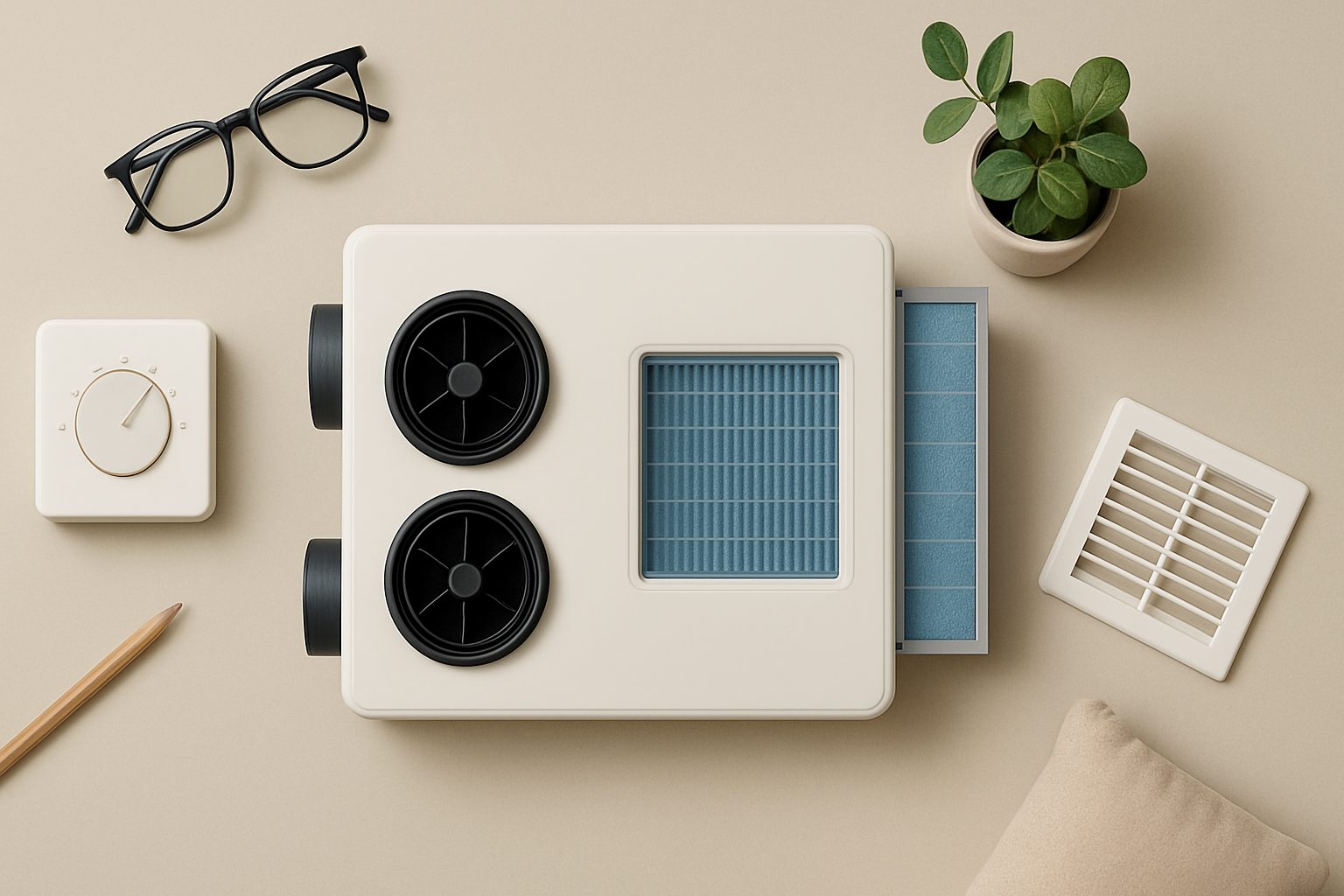
What's actually inside an air handling unit?
An AHU isn't a single component — it's a carefully assembled box containing several interconnected parts:
The heat exchanger. This is the most clever bit. Stale air leaving your home passes through fine passages that sit next to passages carrying fresh, cold outside air. Heat transfers from the outgoing air to the incoming air without them ever mixing. On a cold January morning, this can recover 80–90% of the warmth you'd otherwise lose, which is why these systems are popular in well-insulated homes.
Fans. Two fans sit on either side of the heat exchanger — one pulls stale air out of your home, the other pushes fresh air in. These run continuously at a low speed, or ramp up and down depending on humidity levels and the settings you choose.
Filters. Fresh incoming air passes through filters before entering your home. These trap pollen, dust, and pollutants, which is particularly useful if you live near a busy road or have allergies.
Dampers and controls. These regulate airflow, allowing you to adjust how much air moves through different rooms. Modern systems often have thermostats or humidity sensors that adjust fan speed automatically.
Ducting. Flexible or rigid ducts carry air from the unit to grilles in each room. In retrofit installations (adding one to an existing home), this ducting usually runs through loft spaces or wall cavities.
Why would a UK homeowner consider one?
Airtight homes stay warm longer — which is brilliant for energy bills — but they can trap stale air, moisture, and odours if you don't ventilate properly. Opening windows solves that but costs you the heat you've paid to generate.
An AHU avoids this trade-off. It provides continuous, controlled ventilation without the draughts of open windows. If you've recently upgraded your insulation, fitted new double or triple glazing, or built an extension to modern building standards, an AHU keeps indoor air fresh and prevents condensation issues in bedrooms and bathrooms.
It's also useful if you're sensitive to outdoor air quality — the filters protect you from pollen and pollution. Many UK homeowners near motorways or in urban areas find this genuinely helpful.
The honest pros and cons
The benefits:
- Recovers heat from outgoing air, reducing heating costs by 10–15% in well-insulated homes
- Maintains air quality and humidity without opening windows
- Reduces condensation and damp issues
- Filters out pollen and some air pollutants
- Quieter than fans in individual rooms
- Long lifespan (typically 15–20 years with occasional maintenance)
The drawbacks:
- Initial cost is significant: installation ranges from £3,000 to £8,000+ depending on your home's layout and whether it's a retrofit
- Requires ducting through your home, which means disruption during installation
- Regular filter changes are necessary (typically twice yearly)
- The unit itself needs a dedicated space — usually the loft or a utility cupboard
- If poorly designed or installed, they can be noisy or ineffective
- They need to be balanced correctly, or some rooms might feel draught-free while others are stuffy
How do you know if you need one?
You're a good candidate if:
- Your home is modern or recently upgraded with airtight walls and high-quality windows
- You experience condensation on windows, especially in bedrooms
- Your home feels stuffy or you rely on opening windows constantly for fresh air
- You have allergies or live in a polluted area
- You're building an extension or doing major renovation work
You might not need one if:
- You live in an older, naturally draughty property where air naturally permeates walls and chimneys
- Your home has traditional chimneys or uncontrolled ventilation points
- Your budget is very tight and you can manage with occasional window opening
Next steps
If this sounds relevant to your home, the next questions are usually whether a full MVHR system is worth the investment for your space, what it would actually cost to install, and whether there are simpler alternatives. We've covered both of those topics in more detail elsewhere — including a breakdown of the real installation costs you'd face and a guide to choosing between different AHU systems suitable for UK homes.
For now, the key takeaway is simple: an air handling unit is a practical solution to a genuine problem in modern homes. It's not essential for everyone, but for the right property, it can transform comfort and indoor air quality without draining your heating budget.
More options
- Zehnder ComfoAir MVHR Units (Amazon UK)
- Vent-Axia Sentinel Kinetic MVHR (Amazon UK)
- Mitsubishi Lossnay Ventilation Units (Amazon UK)
- Nuaire Drimaster & Positive Input Ventilation (Amazon UK)
- AHU Replacement Filters & Accessories (Amazon UK)