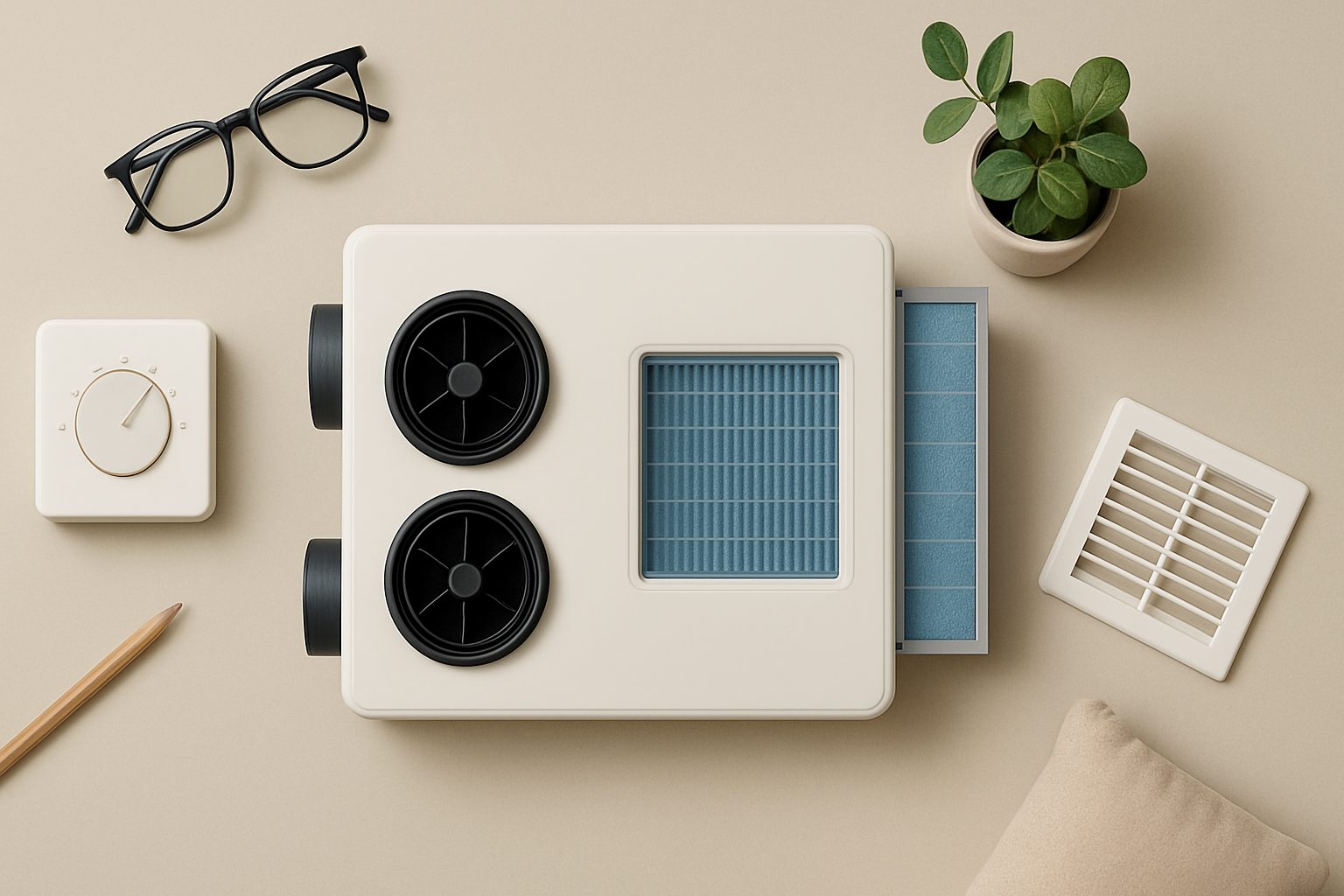
How to Retrofit an Air Handling Unit in an Older UK Property
Retrofitting an air handling unit (AHU) into a 1960s semi-detached house, Victorian terrace, or 1980s bungalow poses genuine challenges that new-build considerations simply don't cover. The UK's older housing stock wasn't designed with mechanical ventilation in mind—spaces are tighter, wall cavities are already occupied, and existing pipework and electrics create routing obstacles. But thousands of older homes now have AHUs working well, and understanding the practical realities upfront saves months of frustration.
Why Older Homes Need Targeted Retrofit Solutions
Pre-2000 UK properties typically have natural ventilation: trickle vents, air bricks, and chimneys provided background air supply. Modern regulations and airtightness improvements have closed many of these pathways, leaving homes either stuffy or damp. An AHU with heat recovery ventilation (HRVI) can maintain fresh air while capturing warmth—critical in properties where you've upgraded windows or insulation.
The retrofit challenge isn't whether an AHU works; it's that older properties force compromises on placement, ducting routes, and unit size. A bespoke approach beats attempting a standard new-build installation.
Key Retrofit Obstacles and Solutions
Space constraints. Older properties have smaller lofts, cramped airing cupboards, and limited plant room options. A full-size residential AHU (roughly 800 × 500 × 300mm) won't fit everywhere. Compact units exist, but they trade flow rate (cubic metres per hour, or m³/h) for footprint. A 300 m³/h unit for a medium semi might be tight; a 150 m³/h compact unit adequate if ducts are well-designed.
Duct routing. This is the real constraint. Older homes have joist patterns, water pipes running under floorboards, and cable runs in unexpected places. Trying to conceal 125mm or 150mm ducts behind skirting boards, through joists, or under floorboards requires careful planning and often some structural accommodation. Loft installation avoids ground-floor disruption, but lofts in older homes are often cluttered with existing services and may have structural timber too low for ductwork to pass beneath.
Loft temperature. Uninsulated lofts in winter drop below freezing. Summer lofts in dark slate-roofed semis can exceed 50°C. An AHU exposed to extreme temperatures loses efficiency and may need additional insulation wrapping or even relocation in summer. Some installers place the unit in a converted loft space; others position it in an airing cupboard or under-stairs and route ducts into the loft only for external air intake.
Building Regulations and moisture. Older homes, particularly solid-wall properties, are often moisture-sensitive. Install an AHU without proper ductwork, sealing, and drainage, and you risk condensation issues. Regulations now require ventilation systems in buildings where windows no longer provide adequate background ventilation—meaning retrofit AHUs now trigger Regulation 4 compliance checks.
Practical Retrofit Installation Locations
Loft installation (most common). The AHU sits in the loft with supply ducts running to each room. Condensate drains back to a soakaway or grey-water system. Works well if: your loft has 1.2m clearance and space around services; you're willing to insulate the unit and ducts; external air can be ducted in from a soffit or wall-mounted intake. Avoid if your loft has severe timber constraints or inadequate depth.
Airing cupboard or bathroom cupboard. Compact units (150–200 m³/h) fit in 800mm × 600mm cupboards, with ducts running through external walls. Condensate drains into existing sink drainage. Thermal comfort is better than a loft, but room humidity in a cluttered cupboard can be problematic. Requires careful installation of the intake/extract ducting to avoid routing conflicts with existing plumbing.
Under-stairs installation. Some Victorian and Edwardian homes have generous understairs voids. A compact unit here keeps the system at moderate temperature and reduces ductwork length. Condensate collection is straightforward. Noise transmission to living spaces above is the trade-off.
Kitchen or utility room. Ducted intake and extract in an existing plant space simplifies installation and maintenance access. Often requires more extensive ductwork to reach bedrooms, making this choice less common in retrofits.
Unit Selection for Older Properties
Retrofit-friendly AHUs share common traits:
- Compact or modular design. Look for units under 600mm in any dimension, or those with removable components.
- Low noise. Older properties have less sound insulation in walls; a unit running at 40dB will noticeably hum through a small loft into a bedroom below. Units below 35dB are preferable.
- Adjustable speed controls. Running at 50–60% capacity in winter reduces noise and energy use; full speed during high moisture periods (cooking, bathroom use).
- Integrated condensate management. Avoid units requiring external pump-out; internal gravity drainage is simpler in retrofits where drainage routes are constrained.
Popular retrofit-suitable models include the Vent-Axia MVHR, Paul Novus 300, and Komfovent Verso in the mid-range, with budget options like the Dantum Eco Step for simpler, non-heat-recovery ventilation.
Installation Reality and Costs
A professional retrofit AHU installation in an older home typically costs £2,500–£4,500 (unit, ducts, commissioning). DIY ducting can cut this by 30–40%, but ductwork sealing and condensate drainage are not forgiving—poor installation triggers dripping, noise, and poor performance.
Lead times for bespoke ducting routes add 4–6 weeks to projects. Early engagement with an installer (survey before you buy the unit) prevents costly rework.
The Honest Trade-Off
Retrofitting an AHU into an older home trades some upfront complexity and cost for genuine year-round air quality and heat recovery. It won't be as seamless as fitting one during new-build construction, and your installation will likely be a hybrid: loft-mounted unit, some ducts concealed in joists, condensate drainage piped to a soakaway, intake routed through a soffit.
The payoff—fresh air, lower humidity, and captured heating—works. But approach it with eyes open: measure your spaces carefully, budget for site-specific ducting, and expect an installer to ask for access to your loft, walls, and pipe runs before quoting. That diligence is what separates a working retrofit from a noisy, damp disaster.
More options
- Zehnder ComfoAir MVHR Units (Amazon UK)
- Vent-Axia Sentinel Kinetic MVHR (Amazon UK)
- Mitsubishi Lossnay Ventilation Units (Amazon UK)
- Nuaire Drimaster & Positive Input Ventilation (Amazon UK)
- AHU Replacement Filters & Accessories (Amazon UK)