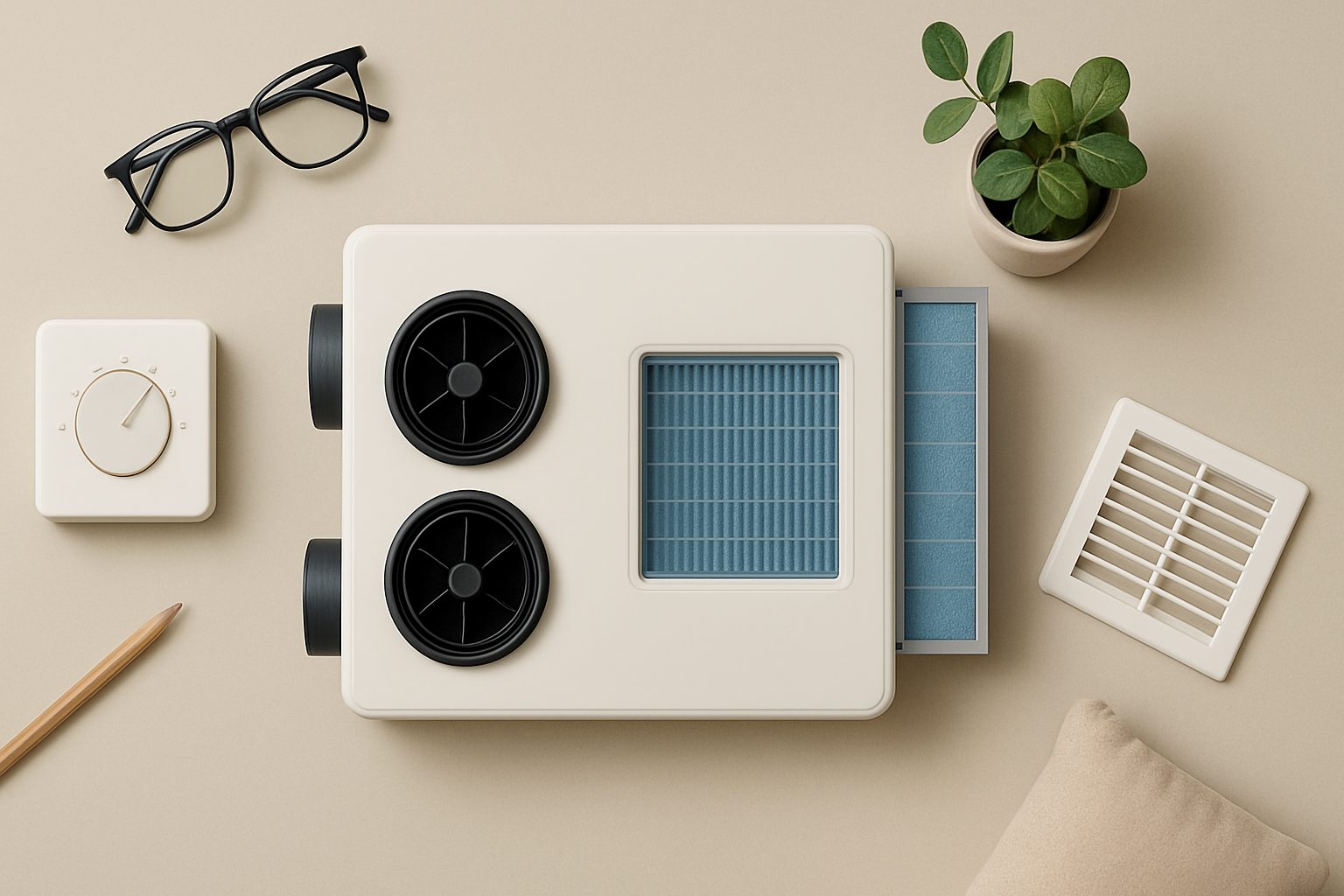
MVHR vs AHU: What's the Difference and Which Is Right for Your UK Home?
If you're upgrading your home's ventilation, you've probably encountered both MVHR and AHU systems. These acronyms throw people off—they're often lumped together in conversations about "air handling"—but they solve different problems and suit different properties. Understanding the distinction will save you time, money, and the hassle of fitting the wrong system.
What is an MVHR System?
MVHR stands for Mechanical Ventilation with Heat Recovery. It's a whole-house ventilation system designed specifically for modern, well-insulated homes. The core principle is simple: extract stale air from wet rooms (bathrooms, kitchens, utility rooms) and bedrooms, then pass it across a heat-recovery core before expelling it outside. Fresh air is simultaneously drawn in from outdoors, warmed by that same core, and distributed throughout the property.
The heat-recovery element is the defining feature. During winter, the warm outgoing air heats the incoming cold air, recovering up to 90% of that heat energy. In summer, the flow reverses, with outgoing warm air cooling the incoming fresh air. This dramatically cuts heating bills and keeps the home comfortable year-round.
MVHR systems are relatively compact and typically installed in a plant room, loft, or under-stair cupboard. Flexible ducts branch off to individual rooms. They're designed for properties that are already reasonably airtight—new builds, retrofitted modern homes, or buildings with solid external walls and careful sealing.
What is an AHU?
AHU stands for Air Handling Unit. It's a broader term covering any system that conditions, moves, and distributes air throughout a building. In a domestic context, you might encounter AHUs in larger properties, commercial adaptations, or homes with more complex climate control needs.
A domestic AHU typically includes components like filters, heating elements, cooling coils, and fans in a single cabinet. Unlike an MVHR, an AHU doesn't necessarily include heat recovery—though it can. AHUs are often used in properties with existing ductwork, particularly bungalows or single-storey homes where running ducts is straightforward. They're also common in commercial buildings, where they handle much larger air volumes.
The key difference: AHUs are flexible but less standardised for residential heat recovery. They're engineered for the specific building rather than being off-the-shelf solutions.
Core Differences Explained
Heat Recovery MVHR is built around heat recovery. AHUs may include it, but it's optional. If you're retrofitting an older, leaky property, heat recovery won't perform well anyway—the building envelope needs sealing first. MVHR only makes sense in tight homes.
Standardisation MVHR systems follow established residential standards (like those from manufacturers such as Vent-Axia, Aeroclean, or Paul). AHUs are more bespoke, engineered by HVAC designers for individual properties.
Installation Complexity MVHR installations follow a predictable route: central unit, ductwork to all zones, filters, controls. AHU installations vary widely depending on the building's layout and existing infrastructure. Some AHUs are retrofit retrofits into existing heating systems; others are completely new.
Noise and Controls MVHR systems tend to be quieter—typically 30–35 dB on standard settings—with simple humidity or CO₂-based controls. Larger AHUs can be noisier and often require more sophisticated ducting and sound attenuation.
Cost MVHR systems cost £3,000–£6,000 installed (materials plus labour). AHU costs are highly variable—commercial-grade units can exceed £15,000 easily. Small domestic AHUs might be cheaper than MVHR, but they won't include heat recovery, so long-term running costs are higher.
When Should You Choose MVHR?
MVHR is your answer if:
- You have a new build or recently retrofitted airtight home
- You've invested in solid insulation and want to preserve that efficiency
- You want to reduce heating bills significantly (expect 5–15% savings depending on climate)
- You prefer a simpler, more standardised installation
- Your property is 2–4 storeys and ductwork runs are manageable
- You're building in a conservation area or where external features are restricted
MVHR won't work well if your home is draughty and leaky—you'll lose conditioned air to gaps in the structure, making the heat recovery ineffective.
When Should You Choose an AHU?
Consider an AHU if:
- You have a single-storey bungalow where ductwork runs are very straightforward
- You need to integrate ventilation with existing heating systems (underfloor heating, heat pumps)
- Your property requires a bespoke solution that standard MVHR units can't deliver
- You want independent control of heating and ventilation
- You're working with an HVAC designer already (for a heat pump installation, for example)
Installation and Maintenance
Both systems need proper commissioning. MVHR units should be commissioned to balance airflow across all zones—many poor-performing systems simply aren't balanced correctly. AHUs, particularly larger ones, need site-specific adjustments and ductwork balancing.
Maintenance is straightforward for both: filters need checking every 3–6 months (MVHR) or monthly (AHU, usually denser filters), and the MVHR heat-recovery core should be inspected annually. With decent filters, both systems can last 15+ years.
The Practical Choice
For most UK homes, especially recent builds and modern retrofits, MVHR is the better choice. It's purpose-built for residential heat recovery, simpler to install, and easier to maintain. AHUs suit larger or more complex properties where ventilation needs to integrate with other systems.
The real decision hinges on your home's airtightness and layout. Have a qualified ventilation surveyor assess your property before committing—they'll flag whether sealing and insulation work is needed first, or whether an AHU might genuinely suit your setup better. The wrong choice now means years of inefficiency or regret later.
More options
- Zehnder ComfoAir MVHR Units (Amazon UK)
- Vent-Axia Sentinel Kinetic MVHR (Amazon UK)
- Mitsubishi Lossnay Ventilation Units (Amazon UK)
- Nuaire Drimaster & Positive Input Ventilation (Amazon UK)
- AHU Replacement Filters & Accessories (Amazon UK)