How Does MVHR Work? A Step-by-Step Guide for UK Homes
Mechanical Ventilation with Heat Recovery (MVHR) is becoming increasingly common in UK homes, especially as building regulations tighten and energy efficiency matters more. But what actually happens inside the unit? And why would you want one? This guide walks through the mechanics so you understand exactly what's going on behind the scenes.
Why Fresh Air Ventilation Matters
Modern UK homes are built tight. Double glazing, insulation, and sealed construction keep warm air in, which is brilliant for heating bills. But there's a problem: with nowhere for stale air to escape naturally, indoor air quality suffers. CO₂ builds up, moisture lingers, and odours stick around. You could open windows, but that loses all your hard-earned heat.
MVHR solves this without the heat loss. It constantly extracts stale air from your home and feeds in fresh air from outside, but passes both through a heat exchanger first. The result: fresh air arrives warm in winter, cool in summer, and you've barely lost any heat.
The Core Components
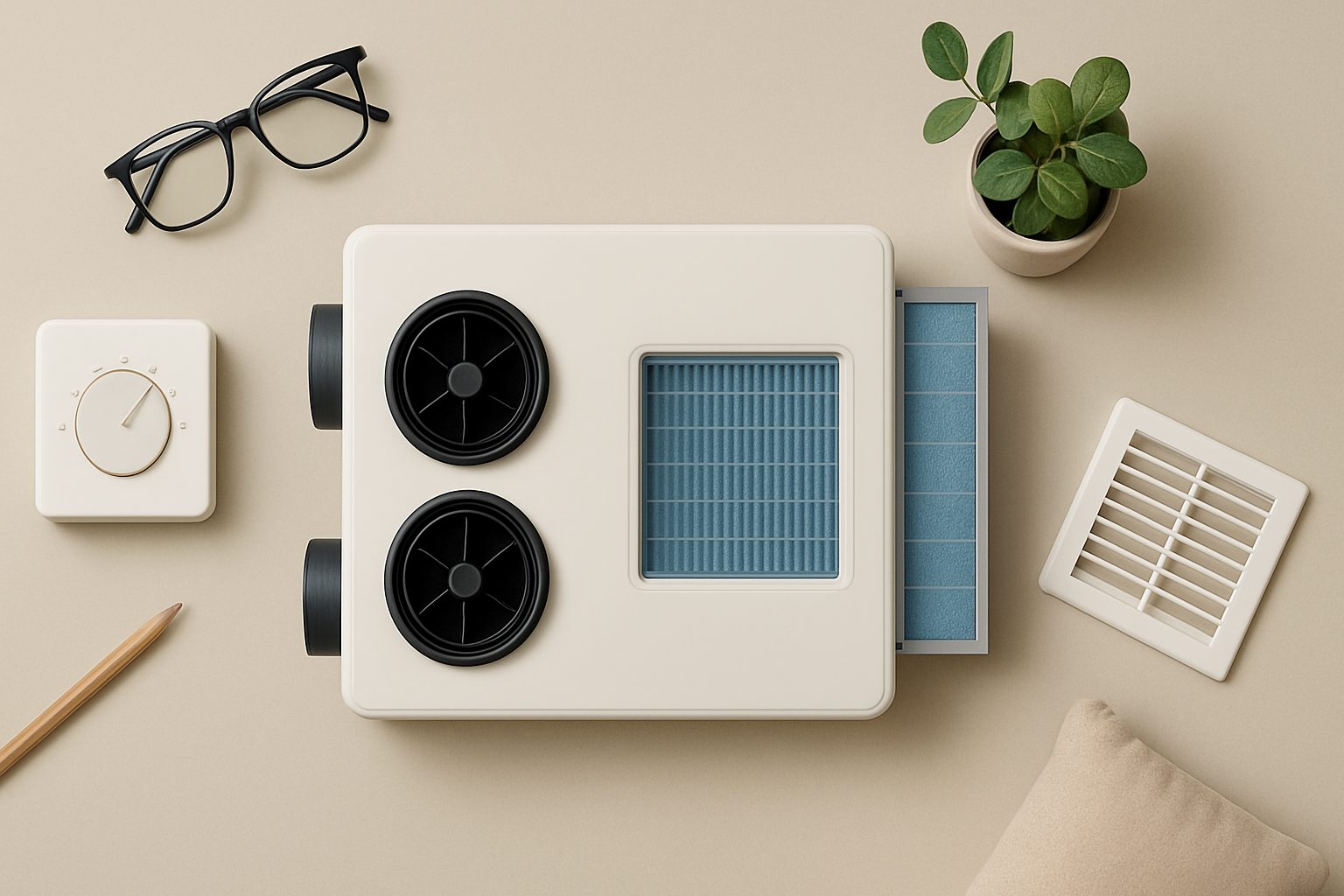
An MVHR system has four main parts: the main unit (usually a box-shaped device installed in a loft, cupboard, or utility room), extract ducts, supply ducts, and filters.
The main unit sits out of the way and contains the heat exchanger—the clever bit—plus two fans. One pulls stale air out of your home; the other pushes fresh air in.
Extract ducts (usually 125 mm or 150 mm diameter) run from wet rooms like kitchens and bathrooms to the unit. These pull out moisture-laden, odorous air.
Supply ducts run from the unit to living spaces: bedrooms, lounges, anywhere people spend time. Fresh filtered air arrives here.
Filters sit in the unit and catch dust and pollutants from incoming outside air before it reaches you.
How the Heat Exchanger Works
This is the heart of the system. Imagine two separate airstreams flowing past each other, separated by thin metal plates inside the heat exchanger core. They never mix—it's all about temperature transfer.
In winter, warm stale air from inside flows one way through the exchanger; cold fresh air from outside flows the opposite way. As they pass close by, heat from the outgoing air transfers to the incoming air through the metal. The outgoing air exits your home much colder than it came in, but the incoming air is warmed by the energy that was about to leave anyway. Typical units recover 75–92% of the heat that would otherwise be lost.
In summer, the same principle works in reverse: warm fresh air from outside passes the cooler exhaust air from your home and is cooled slightly as it enters.
Air Movement and Controls
The unit is constantly running—typically 24 hours a day—to maintain continuous fresh air supply. Two fans control the airflow:
- Extract fan pulls stale air from kitchens, bathrooms, and utility rooms (moisture-heavy areas).
- Supply fan pushes filtered, conditioned air into living spaces.
Most modern MVHR units have adjustable fan speeds. You might run them on low overnight to maintain air quality quietly, then medium-to-high when cooking or after showering to handle humidity spikes. Better units detect humidity automatically and adjust speed accordingly—some even have pull-cord switches in bathrooms so you can boost extraction manually when needed.
Balancing Air Pressure
For MVHR to work properly, the amount of air extracted must roughly equal the amount supplied. Otherwise your home becomes either pressurised or slightly negative, which can cause draughts or draw in unwanted outside air through gaps.
Good MVHR design balances the fans so this happens naturally. Some premium units have smart balancing that adjusts each fan independently—useful if one room naturally has fewer extract points than others.
Condensation and Frost Risk
In very cold UK winters, there's one catch: the stale air you're extracting carries moisture. If it cools too quickly in the heat exchanger, that moisture can condense and even freeze inside the unit. Frost buildup blocks airflow and reduces efficiency.
Quality MVHR units have defrost strategies built in. Some have a motorised bypass damper that occasionally routes incoming air around the heat exchanger, warming it briefly. Others use clever sensor controls to prevent the conditions for frost forming in the first place. Passive units (no fans, purely convection-driven) aren't common in residential UK MVHR, but when they do appear, frost is a genuine problem; actively powered units handle it well.
Noise and Comfort
MVHR units do make noise—quiet running units produce around 30 dB on low speed (comparable to a library), though they're noticeably audible on full speed. The noise comes mainly from the fans and air rushing through ducts. Good installation with flexible ductwork connections, proper duct sizing, and acoustic lagging around ducts keeps things comfortable.
You also don't feel draughts because air enters through multiple low-velocity supply points rather than single vents, distributing it gently around the room.
Running Costs
MVHR fans use electricity constantly. A typical unit draws 30–50 watts on low, perhaps 80–100 watts on high. For 24/7 operation at average speed, expect roughly £60–100 per year in fan electricity, depending on tariffs and usage. That's negligible compared to the heat you retain.
The Bottom Line
MVHR continuously exchanges your home's stale air for fresh filtered air while capturing heat that would otherwise escape. It's not complicated—just two airstreams passing through a clever metal core—but it's remarkably effective at maintaining indoor air quality and comfort without the energy cost of opening windows. For modern, well-sealed UK homes, especially those aiming for better energy efficiency, it's become almost essential.
More options
- Zehnder ComfoAir MVHR Units (Amazon UK)
- Vent-Axia Sentinel Kinetic MVHR (Amazon UK)
- Mitsubishi Lossnay Ventilation Units (Amazon UK)
- Nuaire Drimaster & Positive Input Ventilation (Amazon UK)
- AHU Replacement Filters & Accessories (Amazon UK)