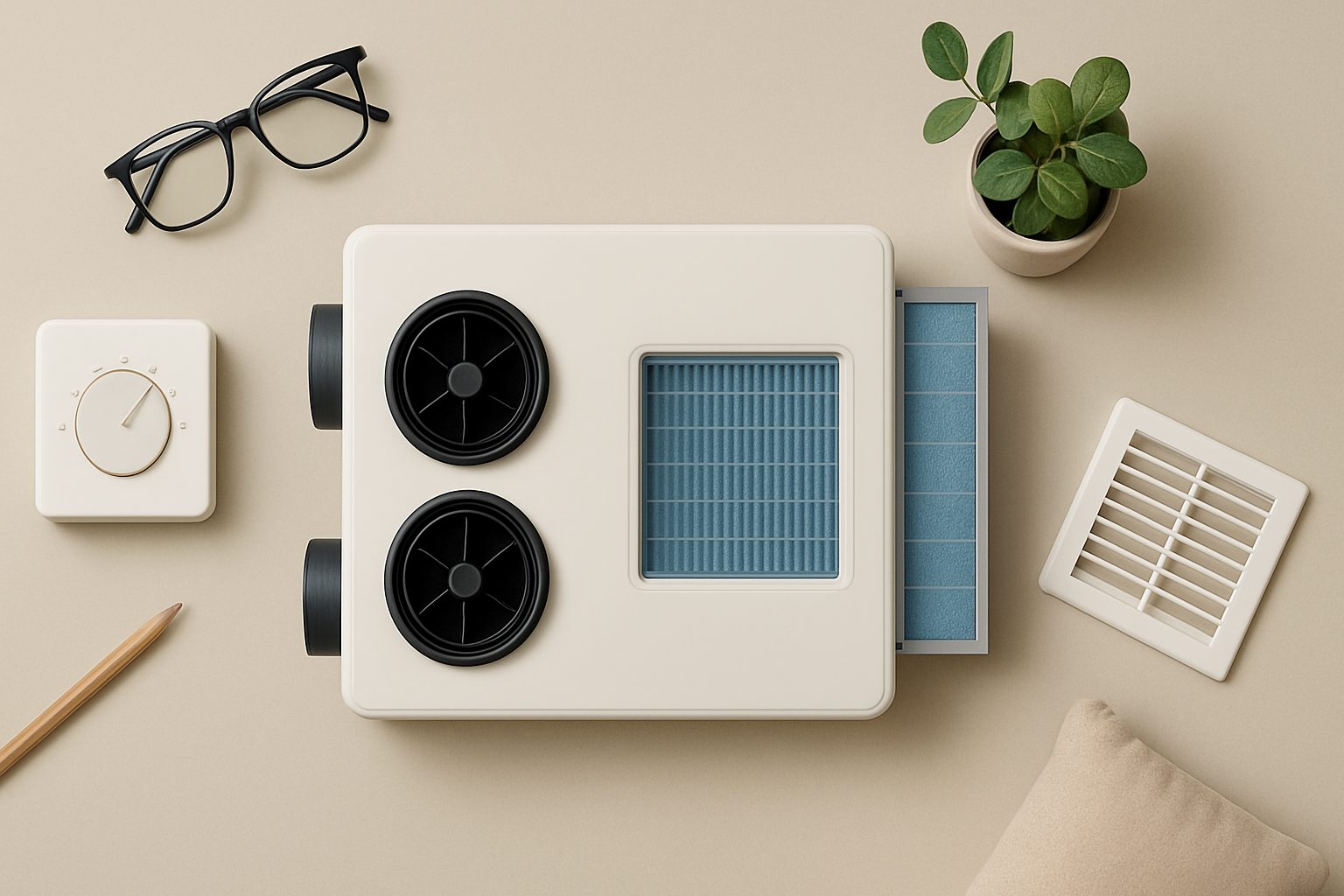
Best Whole-House Air Handling Units in the UK (2025 Expert Picks)
Whole-house air handling units are the backbone of modern home ventilation. In the UK, most are MVHR systems (Mechanical Ventilation with Heat Recovery) rather than traditional AHUs, and choosing the right one makes a real difference to air quality, energy bills, and comfort.
Why Air Handling Matters in UK Homes
Your home generates moisture constantly: showers, cooking, drying clothes, even breathing. Without mechanical extraction, humidity lingers, promoting mould and dust mites. Open windows help but lose heat in winter. MVHR systems solve this by extracting stale air from kitchens and bathrooms while supplying fresh air to living spaces—and crucially, recovering 70–90% of the heat from outgoing air before it leaves.
This is why MVHR has become standard in new UK builds and retrofit projects. It's mandatory under Building Regulations for new homes (Part F ventilation requirements), and works particularly well in airtight properties where natural ventilation alone isn't practical.
MVHR vs. Standard AHUs: What's the Difference?
A standard AHU filters and moves air but doesn't recover heat. You're essentially discarding warm air when you ventilate—fine if you have unlimited heating budget, but wasteful.
An MVHR core swaps heat between incoming and outgoing air streams without mixing them. This means winter ventilation barely dents your heating costs, and summer units can be run passively for cooling. Most UK installers now specify MVHR rather than basic AHUs because the payback is clear.
Key Considerations Before Buying
Noise levels matter more than specs suggest. Look for units rated below 35 dB in normal operation; cheap models can sound like a hairdryer in the loft. Ductwork design and damping contribute as much as the unit itself.
Heat recovery efficiency varies: budget systems recover 75–80%, premium units reach 92%. In a cold climate, that 10–15% difference compounds over 15+ years.
Maintenance access is essential but often overlooked. You'll need to clean or replace filters every 6–12 months, and occasionally service the heat exchanger. Poor design means climbing into an attic in December to wrestle with ducting. Check where components sit and how easy replacement is before installation.
Room coverage depends on ductwork and fan speed. A 300 m³/h unit works in a three-bed semi but not a large manor house. Undersizing means poor extraction; oversizing burns energy and noise.
Filter quality directly affects air quality. Standard G4 filters stop dust and pollen; HEPA filters (often optional) catch fine particles better but need more frequent replacement and raise running costs slightly.
Top MVHR Systems for UK Homes
Ductless ERV units (Daikin, Panasonic, Vaillant) are easiest to retrofit. No ducting means installation avoids rerouting every ceiling cavity. Typically 200–350 m³/h, suitable for flats and tight terraces. Less effective than ducted systems but far cheaper to fit.
Ducted MVHR systems are the standard for new builds and serious refurbs. Market leaders include:
- Zehnder ComfoAir — Swiss engineering, premium price (£3,500–5,000 installed), excellent heat recovery (92%), very quiet. Best if budget allows and you're fitting during renovation.
- Systemair SAVE — Swedish, solid performer, £2,500–4,000. Common in UK social housing. Good component availability if repairs needed.
- Vaillant VEH — German build quality, integrates with heating systems. £2,800–4,500. Most UK engineers know them well.
- Daikin Streamer — Japanese, mid-range (£2,000–3,500). Less common than Vaillant/Systemair but reliable. Customer support variable.
- Budget brands (Heatbox, Intovent) — £1,200–2,000 installed. Acceptable for temporary installations or additions, but noise and longevity trade-offs notable.
What You'll Actually Spend
Unit cost is half the story. Installation labour runs £1,500–3,000 depending on routing complexity, walls to breach, and existing ductwork. If you're retro-fitting a 1960s semi, expect higher costs and more disruption.
Ductless ERVs cost £1,500–2,500 fitted. Ducted systems in new builds run £4,000–8,000 for complete specification (unit, ducts, controls, commissioning).
Running costs are modest: a typical MVHR draws 20–40 watts on low speed, so roughly £50–100 yearly on electricity. Filter replacements add £30–50 annually.
Honest Pros and Cons
Pros: Superior air quality, reduced condensation, quieter homes (sealed windows), winter heat recovery cuts heating bills 10–15% in airtight homes, virtually silent on low speed.
Cons: Installation disruptive and non-negotiable in retrofit. Upfront cost substantial. Poor design choices (undersized ductwork, wrong fan speed settings) waste money and cause noise regrets. Maintenance ignored = performance drops and filter bypass becomes tempting.
The Bottom Line
For new-build detached or semi-detached homes, Zehnder or Vaillant offer longevity and proven performance. For budget-conscious refurbs, Systemair SAVE or mid-range Vaillant cover the middle ground well. Ductless ERVs suit flats and light loads.
The real choice isn't brand—it's whether installation is done correctly. Undersized ducts, poor acoustic wrapping, and mis-balanced fresh/extract fans ruin even premium equipment. Hire installers with MVHR experience and ask to see commissioning reports.
Air handling is invisible infrastructure, so it gets little attention until something goes wrong. Spec it properly now and you won't think about it for 15 years.
More options
- Zehnder ComfoAir MVHR Units (Amazon UK)
- Vent-Axia Sentinel Kinetic MVHR (Amazon UK)
- Mitsubishi Lossnay Ventilation Units (Amazon UK)
- Nuaire Drimaster & Positive Input Ventilation (Amazon UK)
- AHU Replacement Filters & Accessories (Amazon UK)