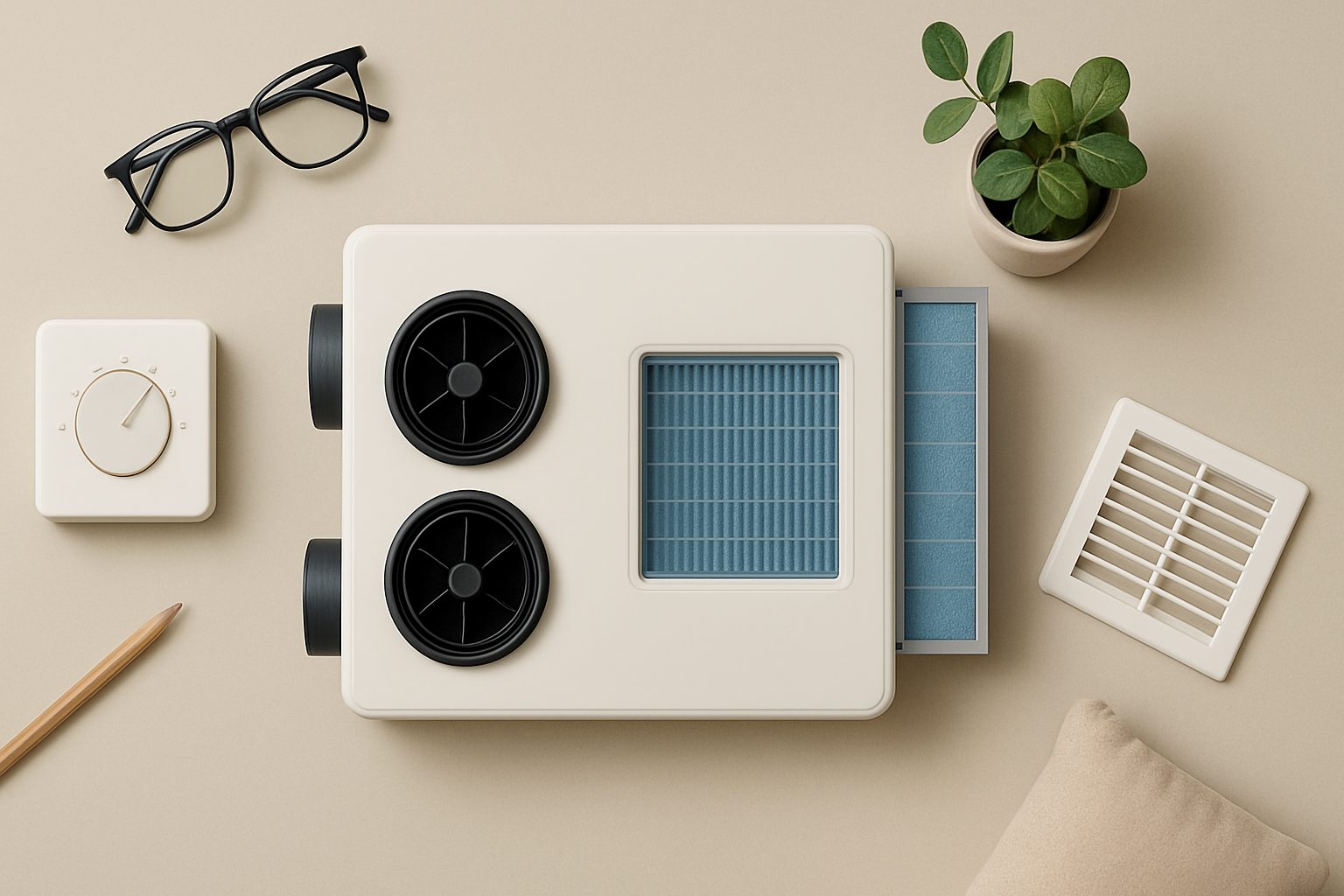
Best Air Handling Units for Passivhaus Builds in the UK
Air handling units (AHUs) are central to Passivhaus performance—they're not optional extras, they're the lungs of your build. If you're designing a self-build or renovation to Passivhaus standards, your choice of AHU will make the difference between exceptional comfort and a system that doesn't quite deliver. The UK market has several proven options, but not all units perform equally under the rigorous demands of ultra-low-energy design.
Why AHUs Matter in Passivhaus
Passivhaus buildings are airtight. That's the whole point—but airtightness without ventilation creates stale air and condensation risk. An AHU solves this by continuously exchanging indoor and outdoor air whilst recovering heat from the outgoing air stream. In heating-dominated UK climates, this heat recovery is critical: a properly sized unit can reduce heating demand by 60-70%.
The key metric is heat recovery efficiency. Passivhaus Standard requires building air changes to be tested, and effective ventilation is non-negotiable. Most certified units achieve 75-85% sensible heat recovery—meaning three-quarters of the heat in your exhaust air stays in the building.
What to Look For
PHI Certification. The Passivhaus Institut (PHI) maintains a database of certified products. Certified units have been independently tested for heat recovery performance, airtightness, and acoustic properties. It's worth checking—not all units marketed as "Passivhaus-suitable" are actually certified.
Heat Recovery Efficiency. Aim for 80%+ on the manufacturer's declaration. Anything below 75% starts to compromise your energy calculations. Real-world performance varies with outdoor conditions and filter cleanliness, so certified figures are more reliable than marketing claims.
Noise Levels. AHUs generate noise—both from the motor and airflow through ducts. Look for units tested to around 30dB(A) at normal operating speeds. If you're installing it in a utility room next to bedrooms, this matters.
Filter Accessibility. Passivhaus requires regular filter changes—typically every 6-12 months depending on local air quality. Some units make this awkward; others have filters you can change from the front. After ten years of ownership, you'll have changed filters dozens of times. Choose a unit where this is easy.
Ductwork Compatibility. UK self-builds often use 160mm or 200mm ducts. Check whether your unit sits comfortably in your ducting plan. Some units have offset inlet and outlet positions; others are more flexible. Get this wrong and you'll need extra bends and fittings that reduce efficiency and increase noise.
The Zehnder ComfoAir 200
The Zehnder ComfoAir 200 is probably the most common AHU in UK Passivhaus builds. It's Swiss engineering—reliable, well-documented, and widely used by self-builders. Heat recovery efficiency is 82% (certified), and it's PHI-listed.
The unit itself is compact and quiet, with filters accessible from the front. Zehnder publishes detailed acoustic and performance data, which is helpful if you're doing detailed energy modelling. It's also relatively straightforward to install once your ductwork is in place.
The catch is cost: around £2,000-2,500 for the unit alone, plus installation, ducting, and controls. For a whole-house system with controls and balancing, budget £4,000-6,000 labour included. It's not cheap, but it's predictable—Zehnder units have a long service life (15+ years) and spare parts are readily available.
Zehnder also makes the ComfoAir 300, which is larger and suits bigger properties or those with high internal heat loads. Choose based on your dwelling's volume and ventilation requirement, not square meterage.
The Paul Novus
The Paul Novus (or Paul Novus 300) is a German alternative with similar credentials: 82-84% heat recovery efficiency, PHI-certified, and increasingly available through UK installers. It's slightly more compact than the ComfoAir 200 and handles similar air volumes.
The Paul Novus sits in the same price bracket and appeals to builds where space is genuinely tight. It has good acoustic performance (around 27dB(A)) and the filter design is straightforward. Availability is narrower than Zehnder—you may need to source it through a specialist ventilation installer rather than a standard HVAC supplier—but that's changing as more UK self-builders discover it.
Other Solid Options
Ductless units (heat-recovery ventilation boxes) are sometimes positioned as AHU alternatives, but they're not—they work for individual rooms, not whole buildings. Skip them if you're aiming for Passivhaus.
Cheaper unidentified units claiming 80%+ efficiency should worry you. Efficiency claims without third-party certification are marketing. In the worst cases, units claiming 85% have measured performance of 65%.
Installation Reality
Installation cost often exceeds unit cost. You'll need:
- Ductwork (flexible or rigid—rigid is quieter and lasts longer)
- Grilles, seals, and fittings
- A dedicated electrical circuit and controls (usually simple on/off or speed control)
- Balancing (checking airflow distribution to ensure all rooms get proper ventilation)
Most self-builders budget 100-150 hours for installation if doing it themselves, or £2,000-3,000 labour if hiring. Book a balancing engineer after commissioning—unbalanced systems don't deliver their rated efficiency.
Running Costs and Maintenance
Annual running cost is minimal—typically £30-60 for electricity on a standard tariff. Maintenance is straightforward: replace filters (£20-40 per year for quality filters) and keep the unit free of dust. Some units have frost protection for extreme cold; the UK rarely needs this, but it's worth checking if you're in a particularly exposed location.
Conclusion
For UK self-builders committing to Passivhaus, a certified AHU with 80%+ efficiency isn't a luxury—it's fundamental to the design working as intended. The Zehnder ComfoAir 200 and Paul Novus are both proven choices; others exist, but always verify PHI certification and independent test data. Installation and balancing matter as much as the unit itself: a poorly ducted or unbalanced system underperforms regardless of the hardware. Expect total system cost around £5,000-7,000 fully installed for a three-bedroom house, and treat it as permanent infrastructure—these units easily outlast most mechanical systems on site.
More options
- Zehnder ComfoAir MVHR Units (Amazon UK)
- Vent-Axia Sentinel Kinetic MVHR (Amazon UK)
- Mitsubishi Lossnay Ventilation Units (Amazon UK)
- Nuaire Drimaster & Positive Input Ventilation (Amazon UK)
- AHU Replacement Filters & Accessories (Amazon UK)