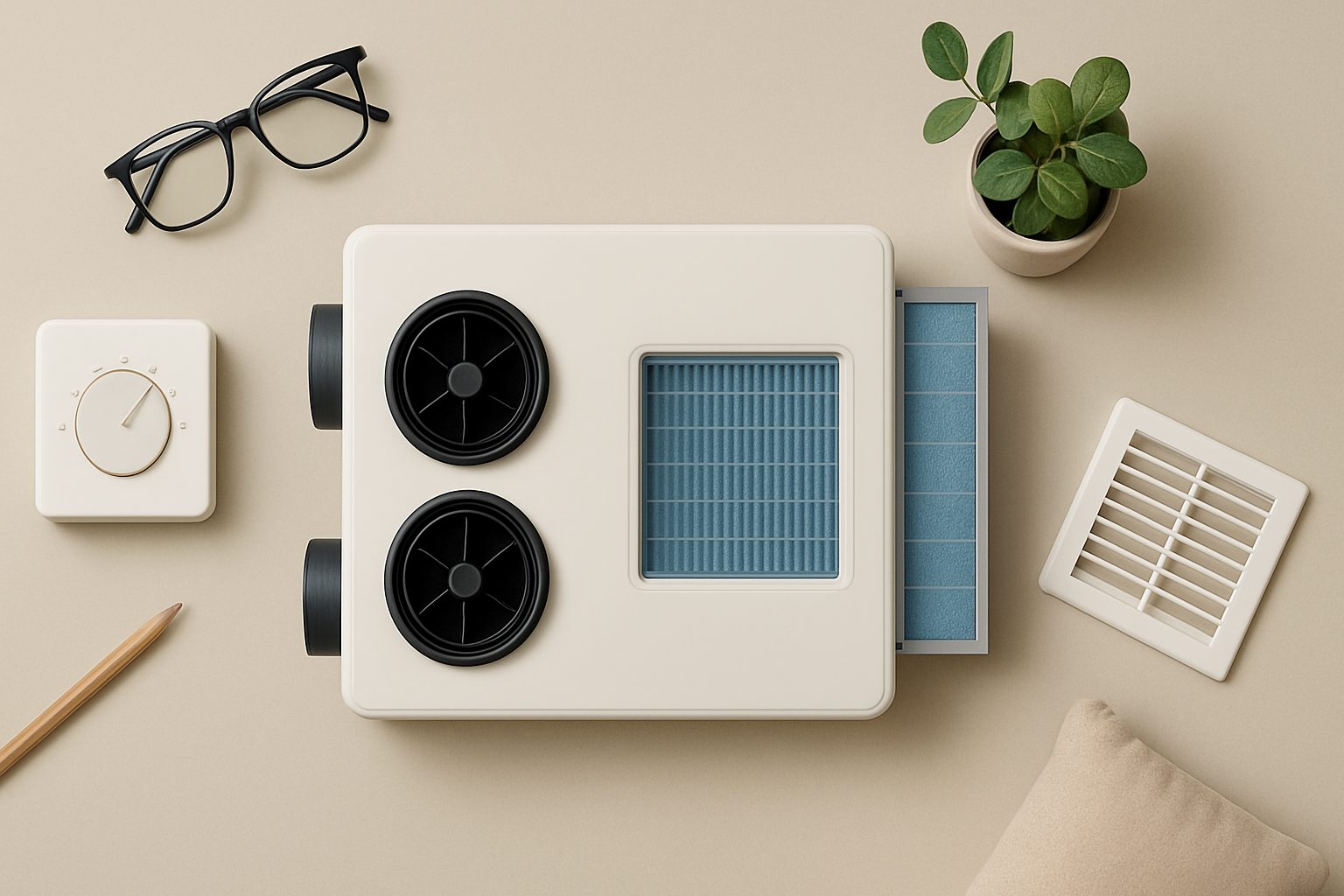
How to Size an Air Handling Unit for Your UK Home (Step-by-Step)
Getting the right air handling unit (AHU) for your home means matching its capacity to your actual ventilation needs—not guessing or following a generic rule of thumb. An undersized unit won't deliver the fresh air your home needs to stay healthy and comply with Building Regulations. An oversized one wastes energy and can make your spaces feel draughty or noisy. This guide walks you through the calculation process so you can size correctly.
Why Size Matters
Building Regulations Part F sets minimum ventilation requirements for all UK homes, whether you're installing a new AHU or upgrading an existing system. Part F specifies the fresh air rate your home must achieve, measured in cubic metres per hour (m³/h). Your AHU must be capable of delivering at least that volume.
Beyond code compliance, proper sizing ensures your ventilation operates efficiently. An AHU that's too weak will run constantly at maximum speed, wasting energy and creating noise. One that's correctly sized can run at lower speeds most of the time, quieter and cheaper to operate.
Step 1: Calculate Your Home's Total Volume
Start by working out the volume of all habitable rooms in your home (bedrooms, living areas, kitchens, home offices—exclude circulation spaces like hallways unless they're significant).
For each room, multiply length × width × ceiling height in metres:
Example: A bedroom 4m long, 3m wide, 2.7m high = 32.4 m³
Add up the volumes of all rooms. This figure is your total air volume.
Typical semi-detached house example: If you have three bedrooms (30, 25, 28 m³), a living room (40 m³), a kitchen (20 m³), and a home office (18 m³), your total is about 161 m³.
Step 2: Apply the Part F Ventilation Rate
Building Regulations Part F divides homes into categories and specifies air change rates. For most residential buildings, the requirement is between 0.3 and 0.5 air changes per hour (ACH).
Air changes per hour means the AHU should replace the entire air volume in your home that many times each hour. The specific rate depends on your building type and whether you have extract-only or balanced ventilation.
For new buildings and major refurbishments with balanced ventilation systems (where fresh air is supplied and stale air extracted), Part F typically requires 0.5 ACH. Older extract-only systems can sometimes operate at 0.3 ACH.
Calculation: Total volume × air changes per hour = required airflow
Using our example: 161 m³ × 0.5 ACH = 80.5 m³/h
This means your AHU needs to move at least 81 m³/h to comply.
Step 3: Account for System Losses
Here's where many installations go wrong: the calculation above assumes perfect conditions. In reality, ductwork, filters, grilles, and bends all create resistance that slows airflow.
A typical well-designed system loses 10–20% of airflow capacity through these components. A poorly designed or heavily filtered system can lose 30% or more.
Apply a safety margin of 1.2 to 1.3 to your calculated requirement:
Example: 81 m³/h × 1.25 = 101 m³/h
This means you'd need an AHU rated for approximately 100 m³/h.
Step 4: Check Room-Specific Requirements
Part F also sets minimum extract rates for specific rooms. Your AHU must deliver at least these rates:
- Kitchens: 10 l/s (36 m³/h) boost rate, or 6 l/s (22 m³/h) continuous
- Bathrooms: 6 l/s (22 m³/h) boost, or 1.5 l/s (5.4 m³/h) continuous
- Utility rooms with a tumble dryer: 8 l/s (29 m³/h)
- Bedrooms: Demand-controlled ventilation or 0.5 ACH per room
Make sure your chosen AHU can meet these individual room requirements and your whole-house target.
Step 5: Consider Noise and Power
Larger AHUs running at maximum speed are noisier and use more electricity. Look at the AHU's noise rating (dB) and specific fan power (SFP) ratings.
A modern AHU should achieve an SFP of below 2 kW/(m³/s)—this tells you how much electricity it consumes per cubic metre of air moved. Better units are significantly more efficient.
For noise, aim for systems that deliver your required airflow at below 35 dB during normal operation. Oversizing often means the unit runs at lower speeds where it's quieter and more economical.
Step 6: Choose Your AHU Size Band
Most manufacturers group their units into broad categories:
- Small (40–80 m³/h): Flats, small terraces, single rooms with extract fans
- Medium (80–150 m³/h): Semi-detached houses, most three-bedroom homes
- Large (150–250 m³/h): Detached homes, large properties, buildings with high occupancy
- Extra-large (250+ m³/h): Large detached homes, multi-storey properties, commercial spaces
Your calculated requirement falls into one of these bands. Choose an AHU rated for the minimum of your required flow—oversizing by 50% is wasteful, but undersizing even slightly breaks compliance.
Common Sizing Mistakes
Multiplying room count by an arbitrary figure: A home's ventilation needs depend on volume and occupancy, not just "one unit per bedroom."
Ignoring ductwork layout: Long runs of ductwork, lots of bends, and fine filters increase resistance. Account for this in your margin.
Assuming Part F requirements are maximums: Part F sets minimums. If your home is larger or has more occupants, you may need to exceed the base calculation.
Choosing by marketing specs alone: Published "maximum" airflow figures are often tested with zero resistance. Real-world performance is lower.
Final Check
Once you've chosen an AHU, verify:
- It delivers your calculated m³/h at the static pressure your ductwork creates (usually 100–150 Pa for residential systems)
- Noise levels are acceptable to you
- Energy consumption fits your budget
- It can be serviced (filters, heat recovery cores) without major disruption
Proper sizing isn't complicated, but it does require understanding your home's specific needs. Get it right and your ventilation system will keep your home healthy and efficient for 15+ years.
More options
- Zehnder ComfoAir MVHR Units (Amazon UK)
- Vent-Axia Sentinel Kinetic MVHR (Amazon UK)
- Mitsubishi Lossnay Ventilation Units (Amazon UK)
- Nuaire Drimaster & Positive Input Ventilation (Amazon UK)
- AHU Replacement Filters & Accessories (Amazon UK)